Showing posts with label corruption. Show all posts

Saturday, 8 November 2014

Mr Pip


On worn torn Bougainville Island, a teacher (the only white man in the village) – begins to read at school each day from Charles Dickens’s classic Great Expectations. He becomes known as ‘Mr Pip’ and inspires his students especially the young Matilda. Bougainville is no longer an island paradise – it’s a ravaged, murderous place where children are forced to live by their wits. After a series of tragic events Matilda begins to lose her will to live, but is revived by the memory of Pip and the power of literature to offer escape and solace in the worst of times.

A little Gauguin, a bit of Lord Jim, the novel's lyricism evokes great beauty and great pain.
Kirkus Reviews, July 1, 2007.

In a novel that is at once intense, beautiful, and fablelike, Lloyd Jones weaves a transcendent story that celebrates the resilience of the human spirit and the power of narrative to transform our lives.   Fantastic Fiction website.

Citation:  Jones, Lloyd. Mister Pip. Melbourne : Text Publishing, 2008.  220 pages.


The novel was shortlisted for the Man Booker Prize in 2007.  It won the 2007 Commonwealth Writer's Prize for best book in Southeast Asia and the South Pacific and the 2007 American Library Association Literary Awards

Also available in large print, audiobook and movie.

Click here to watch the Mr Pip movie trailer.


Generation loss

Art needs light – look at the lack of it. Patti Smith, book frontpiece.

Generation loss: the loss of quality between subsequent copies of data, such as sound recordings, video, or photographs.

Music is a big part of this novel about Cass Neary – a photographer whose hard living lifestyle has caught up with her. This self-destructive anti-heroine was once famous for her pictures of the 1970s New York punk scene. Now she has been forgotten and jobs are hard to come by. As a mercy mission, an old friend assigns her to interview iconic 60s photographer, Aphrodite Kamestos who lives as a recluse on her own private island off the coast of Maine. Aphrodite is not interested in being interviewed by Cass.

On the island Cass learns ‘that a commune Aphrodite helped found has taken her bleak aesthetic to the next level in an effort to penetrate mysteries of life and death.’ – Publishers Weekly.

“Cass confronts a horrifying embodiment of the extremes to which her own artistic inclinations could lead…Hand explores the narrow boundary between artistic genius and madness in this gritty, profoundly unsettling literary thriller.” – Publishers Weekly (starred review)

Citation: Hand, Elizabeth. Generation Loss. Northampton, MA: Small Beer Press: Distributed to the trade by Consortium, 2007. 320 pages.

Read about the author + reviews and her other books at the Elizabeth Hand website. Watch her video interview


Thursday, 6 November 2014

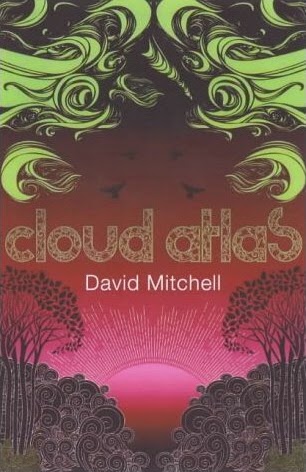
Cloud Atlas

 
An ambitious novel presenting six different stories set in different time periods. Each story is read by the main character in the next chapter. After the sixth story, the other five stories are returned to and closed. The first begins in Chatham Islands (a remote Pacific archipelago off the coast of New Zealand) with the diary of a 19th-century notary. The second story shifts to 1931 with the letters of a penniless composer in 1931 Belgium. Then we meet a 1970s reporter who gets in the way of a nuclear energy company in California and a genetically engineered serf in a future "corpocracy" who slowly gains awareness of her plight. Finally we return to the Chatham islands, only centuries later in a post-civilisation world.

...brilliantly original fiction that reveals how disparate people connect, how their fates intertwine, and how their souls drift across time like clouds across the sky. –
Goodreads 
 

Citation:
Mitchell, David. The cloud atlas. London : Sceptre, 2004.

Available as a CD audiobook, kindle ebook + an enhanced edition with audio and video. Adapted for film starring Tom Hanks, Halle Berry.


Watch the video interview with David Mitchell :


Monday, 13 October 2014

Bodily Harm

Rennie is a young journalist whose comfortable world falls apart when she discovers that she has breast cancer. After her operation, she returns to find policemen in her apartment, investigating the presence of an intruder, an invader who has made himself at home in her kitchen and left a length of rope on her bed. Unnerved by these events, she decides on a holiday escape. She flies to St. Antoine, a fictitious Caribbean island.

...on the tiny island of St.  Antoine she is confronted by a world where her rules for survival no longer apply.  By turns comic, satiric, relentless, and terrifying, Margaret Atwood's Bodily Harm is ultimately an exploration of the lust for power, both sexual and political, and the need for compassion that goes beyond what we ordinarily mean by love. Random House.

CITATION: Atwood, Margaret. Bodily Harm. New York : Bantam Books, 1996. 


Available in large print, audiobook, ebook. Look inside or listen to a sample at Amazon
.
Listen to Margaret Atwood interviewed
by Fay Weldon about Bodily Harm. (British Library mp3).